A Letter to Our Supporters from the Co-Founder
/Dear D.R.E.A.M. Family,
It’s been a while since I’ve checked in and shared some updates with our community, so I wanted to take a moment to reconnect. And let’s be honest, 2026 already feels like a lot.
Across nearly every aspect of society, we’re experiencing profound change. From rising geopolitical tensions in the Middle East to the rapid advancement of AI and its implications for white-collar work, the world feels like it’s shifting under our feet. Add to that the lingering psychological and physical aftershocks of the COVID-19 pandemic, an event that fundamentally reshaped how we work, learn, and live, and it’s no surprise that many people feel unsettled. Yet every day we’re expected to move forward as if everything is normal.
If you’ve felt a little off, a little uncertain, or even a little overwhelmed, you’re not alone.
As Drake once said, “I been peepin’ what you bringin’ to the table.” And right now, what the world is bringing to the table is a lot of uncertainty. But uncertainty also creates opportunity, especially when people have the tools and knowledge to navigate it.
That is where our work at D.R.E.A.M. comes in.
Quiet Years. Important Work.
From the outside, it may have seemed like we were quiet over the last few years. But behind the scenes, the work never stopped. Like many nonprofit organizations that provide direct services to youth, the pandemic disrupted our core model. Our programs were built around in-person conversations, mentorship, and direct engagement with students.
Overnight, that changed.
It forced us to rethink everything about how we operate and how we reach young people. That disruption was painful but it was also transformative.
We began reimagining how we deliver financial education, exploring new ways to reach young people beyond physical classrooms and community spaces. What emerged from that process was a hybrid approach. While we remain firm believers in the power of in-person dialogue and mentorship, we also recognize that digital platforms allow us to expand our reach and scale our impact in ways we couldn’t before.
And I’m excited to share that we’ll soon be launching several new initiatives and events in the months ahead.
The Conversation Around Money Is Changing
When we started D.R.E.A.M. in 2009, financial literacy, especially in underserved communities, wasn’t a mainstream conversation. Today, it is.
Organizations like Operation HOPE and the Jump$tart Coalition continue to do vital work to advance the financial literacy within underserved communities and schools. Influencers like Tiffany “The Budgetnista” Aliche have built massive communities around financial empowerment. And podcasts like Earn Your Leisure’s Market Mondays are bringing investment conversations to entirely new audiences.
I’m also excited to contribute to the ecosystem with my latest venture, Hustle & Finance, a digital media platform focused on producing accessible personal finance content for young adults. The goal is simple: meet the next generation where they are (online) and equip them with the tools they need to build real financial independence.
This collective effort is moving the needle, but the data tell us there is more work to be done.
Progress is Happening. But It’s Not Enough.
At the policy level, we’re starting to see progress. More states than ever now require financial literacy courses for high school graduation. As of April 2026, 31 states have adopted some form of mandate. Hawaii recently joined that group, requiring students to complete a financial literacy course beginning in the 2026–27 school year.
Is that progress? Absolutely.
Is it enough? No.
Financial literacy still isn’t a universal high school graduation requirement across all 50 states, and even where mandates exist, implementation is inconsistent. But compared to where we were nearly two decades ago, the momentum is real and encouraging.
According to the OECD’s PISA Financial Literacy Assessment, which measures how well teenagers understand and apply financial concepts, the United States ranked 8th out of 20 participating countries. Even more concerning, 17% of U.S. students scored at or below the lowest proficiency level. In other words: nearly one in five students lacks even the most basic financial knowledge.
That tells us something important: the conversation is growing, but the work isn’t finished.
April is Our Moment
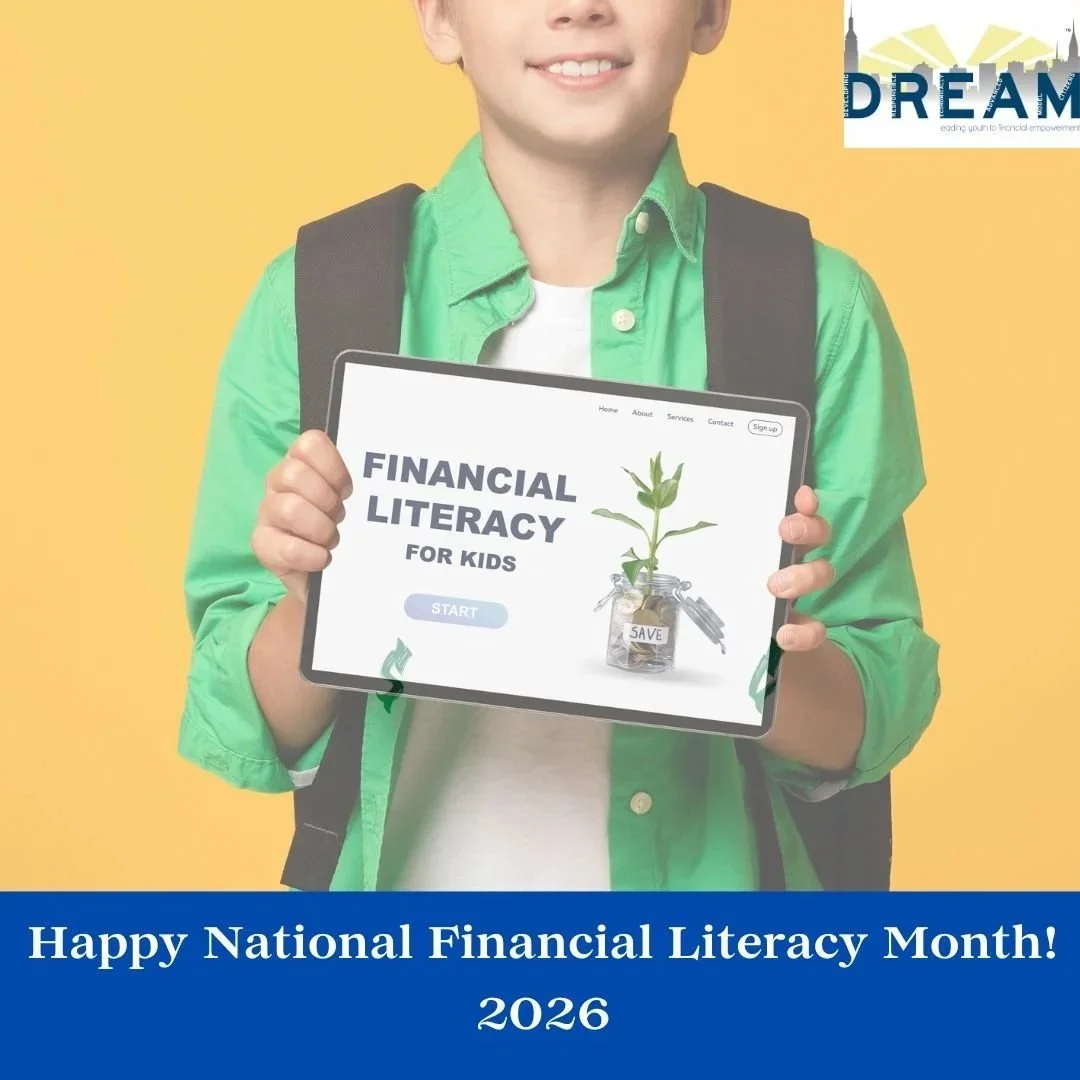
Every year, April marks National Financial Literacy Month, one of my favorite times of the year. It’s an opportunity for all of us to pause and engage more intentionally with our financial knowledge, habits and mindset. I try to approach it the same way every year: by learning one thing about money that I didn’t know before. The science of money is constantly evolving as new tools, technologies, and financial products emerge. Financial literacy isn’t a destination, but rather a lifelong journey.
So, this April, I want to challenge our community to lean in.
Read a book about money.
Listen to a podcast episode about personal finances.
Attend a financial literacy event.
Have a real conversation about money with someone in your life.
There are many exciting updates coming for D.R.E.A.M. in the months ahead, and I look forward to sharing more soon.
Thank you, as always, for your continued support.
About the Author: Femi Faoye is the Co-Founder and Chief Executive Officer of D.R.E.A.M. He’s a staunch and passionate financial literacy education advocate. You can follow his insights on twitter @HustleNFinance.
Disclaimer:
Notwithstanding any language to the contrary, the views expressed in this post reflect those of the author and are solely theirs and do not reflect the views of Developing Responsible Economically Advanced Model-Citizens, Incorporated or any affiliates. Opinions are based upon information the author deems reliable but Developing Responsible Economically Advanced Model-Citizens, Incorporated does not warrant its completeness or accuracy and should not be relied upon as such. Neither the author nor Developing Responsible Economically Advanced Model-Citizens, Incorporated guarantees any specific outcome or profit from recommendations presented and you should be aware that losses may occur following any strategy or investment discussed. This material does not take into account your particular investment objectives, financial situation or needs. Before acting on information in this post you should consider whether it is suitable for your particular circumstances and strongly consider seeking advice from your own financial or investment adviser.
The contents of this post cannot be redistributed without the explicit written consent of the author and Developing Responsible Economically Advanced Model-Citizens, Inc. All images in this post owned by Developing Responsible Economically Advanced Model-Citizens, Inc. may not be used in any advertising, publicity, or otherwise to indicate members' sponsorship or affiliation with any product or service without the prior express written consent of Developing Responsible Economically Advanced Model-Citizens, Inc. All other images presented not owned by Developing Responsible Economically Advanced Model-Citizens, Inc. are the property of the author, respective company, or photographer. The rights to the images and likeness represented are under explicit ownership of the person(s) aforementioned.